
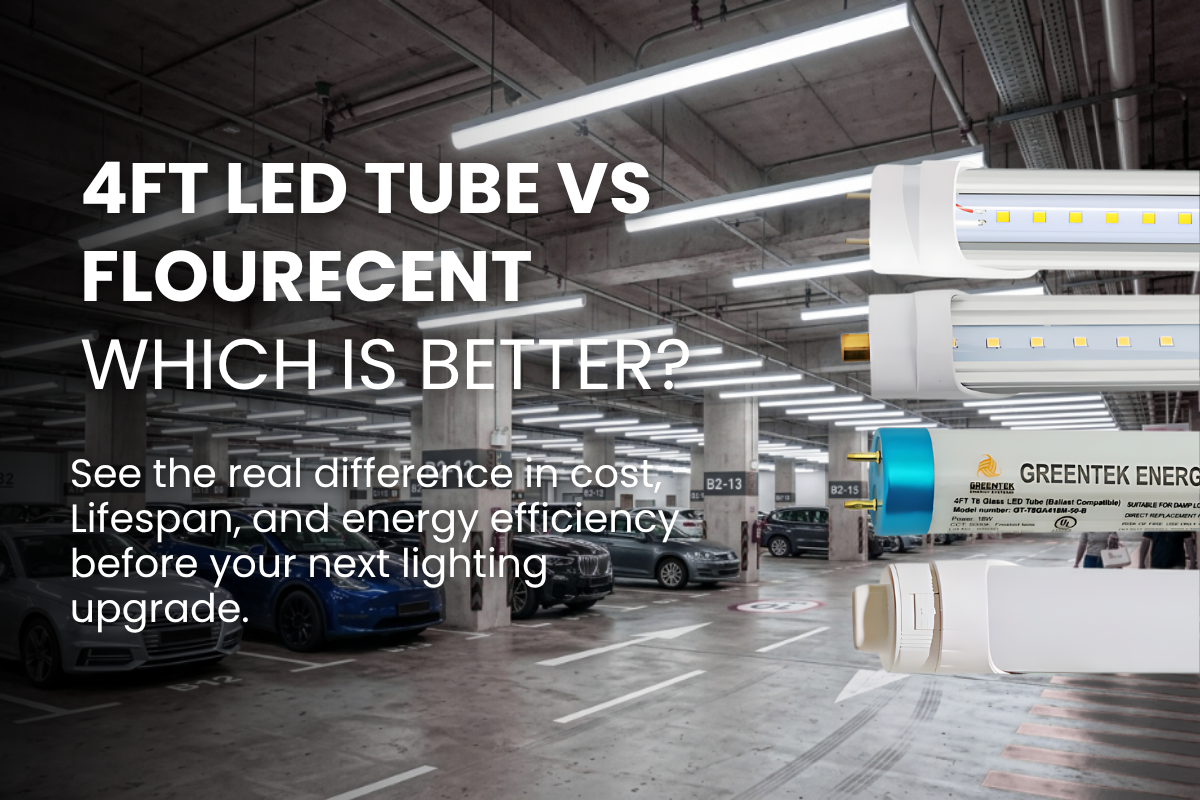
Introduction
Let's be honest — nobody really thinks about their lighting until the electricity bill lands on the desk. Then suddenly it becomes a very interesting topic.
If you're running a warehouse, a retail shop, or even a mid-sized office, lighting probably makes up a bigger chunk of your monthly energy spend than you'd like. The good news? It's also one of the simplest areas to fix.
A lot of businesses have quietly moved away from fluorescent tubes over the last several years. Not because of some trendy green initiative, but because the math just works out. Switching to 4ft LED tubes cuts energy costs, reduces how often you're climbing ladders to swap out dead tubes, and generally makes the whole lighting situation less of a headache.
This article walks through the actual differences between LED and fluorescent — cost, lifespan, efficiency, and everything in between — so you can make a straightforward decision.
What Are 4ft LED Tubes?
4ft LED tubes are basically the modern replacement for the long fluorescent tubes you see in most commercial ceilings. They're built to drop into the same fixtures, so you're not tearing anything out and starting from scratch.
They show up just about everywhere — offices, warehouses, schools, grocery stores, hospitals, parking structures. If a building was built in the last 50 years and has overhead lighting, there's a good chance it was designed around fluorescent tubes. LED tubes are built to replace them without a full fixture overhaul.
There are two ways to install them:
-
Ballast bypass (direct wire): You wire the tube directly to your power supply and take the ballast out of the equation. A bit more work upfront, but it removes a part that will eventually fail anyway.
-
Plug-and-play: These work with your existing ballast, so installation is quick. The catch is that if your ballast dies, you're back to troubleshooting.
T8 is the most common size you'll come across for commercial spaces. Green Light Depot carries a solid range of both types, so finding something that fits your current setup isn't a problem.
What Are Fluorescent Tubes?
Fluorescent tubes have been around since the 1950s and were genuinely a big deal when they came out. They work by running electricity through a tube filled with gas — mercury vapor, specifically — which then causes a phosphor coating inside the tube to glow.
They were practical, affordable, and good enough for decades of commercial use. That's why they ended up in virtually every office and retail space built in the second half of the 20th century.
But the drawbacks have always been there. They need a ballast to work. They flicker, especially as they age. Mercury makes disposal a regulated process. And they don't last nearly as long as people assume. New fluorescent installations have become pretty rare — most contractors aren't specifying them for new builds anymore.
LED vs Fluorescent: Energy Consumption
This is the section most people actually care about, so let's get into it.
A typical T8 fluorescent tube runs at 32 watts. A modern LED replacement for that same fixture runs somewhere between 15 and 18 watts — and often puts out the same amount of light or slightly more. That's a 40 to 60 percent drop in energy use, per tube, right away.

Now scale that across a facility with 80 or 100 fixtures running through a full workday. The numbers add up fast.
|
Feature |
4ft LED Tube |
Fluorescent Tube |
|
Wattage |
15–18W |
28–32W |
|
Lumens per Watt |
100–150 lm/W |
60–90 lm/W |
|
Energy Savings |
Baseline |
40–60% more energy used |
|
Heat Output |
Very low |
Moderate to high |
|
Instant On |
Yes |
Slight warm-up needed |
One thing people often miss: fluorescent tubes throw off a fair amount of heat. In any space with air conditioning, that heat has to go somewhere — meaning your HVAC system works harder. LED tubes run cool, so that hidden cost quietly disappears too.
Lifespan: Which Lasts Longer?
This one isn't close.
A decent LED tube is rated for around 50,000 hours. A fluorescent tube typically gives you somewhere between 10,000 and 15,000 hours before it needs replacing. That means by the time you're swapping out your third or fourth fluorescent tube, your LED is still running.
For a business operating 10 hours a day, fluorescent tubes might last two to four years. That same LED tube? Easily a decade or more.
And the real cost of a dead fluorescent tube isn't just the tube itself. It's the person who has to notice it, the work order, the ladder, the time. In warehouses or spaces with high ceilings, that's not a five-minute job. Multiply it by how often it happens across dozens of fixtures, and the labor cost alone becomes a real number.
Fewer replacements means fewer interruptions, lower maintenance bills, and less stuff to manage.
Upfront Cost vs Long-Term Savings
LED tubes do cost more to buy. A fluorescent tube might run you three to six dollars. A comparable LED tube is typically eight to fifteen dollars. That's a real difference, especially if you're outfitting a large space.
But here's how the math shakes out over time:
-
A 32W fluorescent tube running 10 hours a day costs roughly $11.68 per year in electricity
-
A 16W LED tube in that same spot costs roughly $5.84 per year
That's about $6 saved per tube, per year, just in electricity. In a 100-fixture space, you're looking at $600 annually before you even count the tubes you didn't have to buy or the maintenance calls you didn't have to make.
Most businesses that go through a full LED retrofit recover their investment within one to two years. Everything after that is money back in your pocket. Add utility rebates into the mix — many power companies offer them for LED upgrades — and the payback timeline gets even shorter.
Which Is More Eco-Friendly?
Fluorescent tubes contain mercury. That's not a minor footnote — it means every burned-out tube has to be treated as hazardous waste. You can't just toss them in the trash. There are disposal regulations, and if you're going through a lot of tubes, that's a compliance issue you're dealing with on a regular basis.

LED tubes have none of that. No mercury, no hazardous materials, no special disposal process. They're also pulling significantly less power from the grid, which means a smaller carbon footprint at the facility level.
For any business working toward sustainability targets or trying to meet green building standards, switching to LED is one of the easiest boxes to check.
Brightness, Flicker & Performance
If you've ever worked a long day under old fluorescent lights and felt oddly drained by the end of it, the flickering is part of the reason. Fluorescent tubes flicker — sometimes in a way you can see, sometimes at a frequency just below conscious awareness. Either way, it adds up over hours of exposure.
LED tubes don't flicker. They're on, steady, the moment you hit the switch.
A few other things worth knowing:
-
Instant on: No warm-up time, no gradual brightening. Full output immediately.
-
Color rendering: Quality LED tubes typically have a CRI of 80 or higher, which means colors look more like they do in natural light. That matters in retail, in food service, in anywhere appearance counts.
-
Directional output: LEDs send light where you actually need it, rather than scattering it in all directions. You get more usable light on the work surface.
-
Cold weather performance: Fluorescent output drops noticeably in cold environments. LEDs are largely unaffected.
Final Verdict: LED or Fluorescent?
If you genuinely need the cheapest possible option today and you're only operating for another year or two, fluorescent is technically less expensive to purchase. That's it. That's the only argument for fluorescent in 2024.
For everyone else — businesses planning to operate for more than a couple of years, anyone paying a monthly electricity bill, facilities that deal with ongoing maintenance — LED wins on every count. Lower energy use, longer life, better light, simpler disposal.
Explore high-performance 4ft LED tubes if you're ready to make the switch. Whether it's one room or an entire facility, the savings start from day one.
Conclusion
When you look at the full picture — energy costs, replacement frequency, maintenance time, environmental compliance, light quality — fluorescent tubes don't have much of a case anymore.
LED technology has gotten good enough, and affordable enough, that the upgrade makes sense for virtually any commercial space. The upfront cost is real but manageable, and the payback window is shorter than most people expect.
Green Light Depot makes it straightforward to find what you need and get the job done without overcomplicating it.
The only real question is how long you want to keep paying more than you have to.