
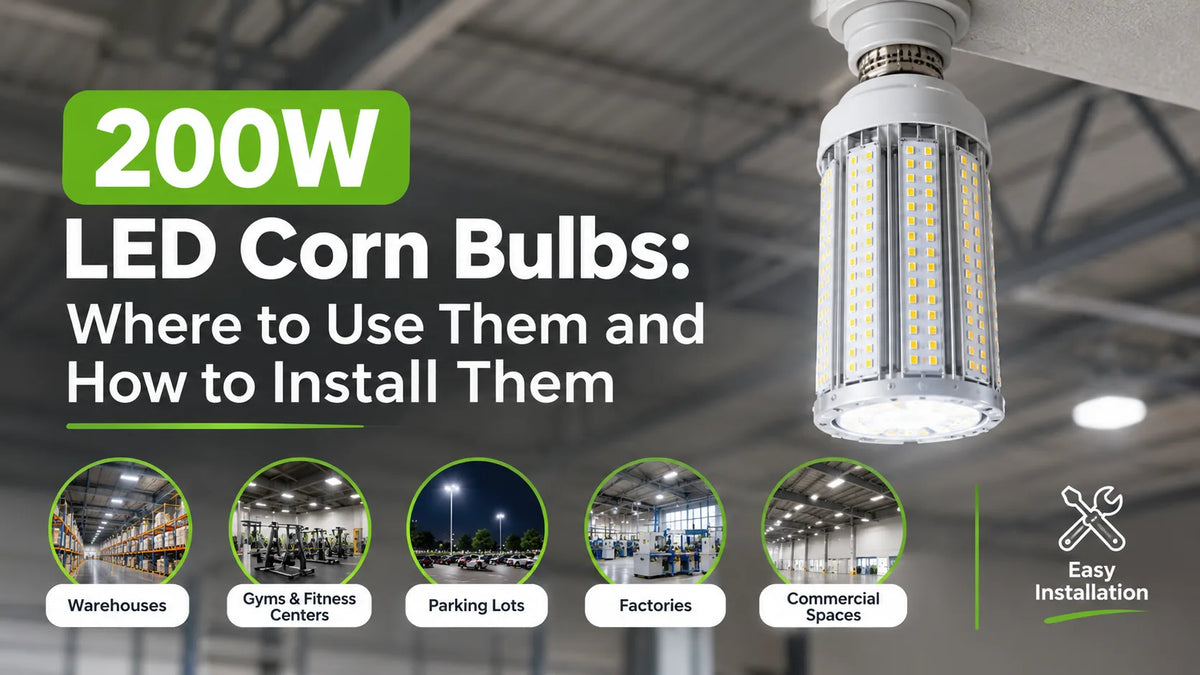
200W LED Corn Bulbs: Where to Use Them and How to Install Them
Many warehouses, barns and parking lots still run 600W metal halide lamps. A 200W LED corn light bulb is one of the simplest ways to upgrade them. It screws into the same E39 mogul socket, puts out about 25,000 lumens and draws 200W instead of 600W.
Here's what a 200W corn bulb is, where it works best, how to install it and what it saves.
Key takeaways
-
A 200W LED corn bulb is rated to replace a 600W metal halide, HPS or HID lamp in the same E39 socket.
-
It suits high ceilings and big areas: warehouses, gyms, barns, and parking-lot fixtures that are open or vented.
-
It needs a ballast bypass at install. After that it draws a third of the power and is rated for 50,000 hours.
What is a 200W LED corn bulb?
A corn bulb is an LED lamp with hundreds of small LED chips set around a cylinder, like kernels on a cob. The chips face every direction, so the light spreads 360 degrees, just like the metal halide or high-pressure sodium (HPS) lamp it replaces. Our post on 360-degree corn bulbs shows how they're built.
At 200W, this is a commercial lamp, not a household bulb. It needs a large E39 mogul socket, and 25,000 lumens is far more light than a room in a home needs.
|
Spec |
200W LED corn bulb |
|---|---|
|
Wattage |
200W, switchable to 170W or 150W with a knob on the lamp |
|
Light output |
24,400–26,000 lumens (122–130 lumens per watt) |
|
Replaces |
600W metal halide, HPS or HID lamps |
|
Base and beam |
E39 mogul, 360° |
|
Color |
5000K daylight white, CRI 80+ |
|
Voltage |
120–277V AC |
|
Listings |
UL and DLC listed, rated for damp locations |
|
Surge protection |
4kV |
|
Life and warranty |
Rated 50,000 hours, 5-year warranty |
200W LED corn bulb uses: where it works best
-
Warehouses and factories. High-bay fixtures that held a 600W metal halide lamp.
-
Gyms, arenas and big-box stores. High ceilings that need even light across a wide floor.
-
Barns and large workshops. Fixtures that hang high and run for long hours.
-
Parking lots and building exteriors. Area lights and wall packs that take a mogul-base lamp. The bulb is rated for damp locations; use open or vented fixtures, as the spec sheet recommends, since fully sealed housings trap heat.
If your fixture points light straight down, a 180-degree directional corn bulb puts more of its light where you need it. If the fixture itself is old or damaged, a new UFO LED high bay may make more sense than a retrofit.
Pick the right corn bulb for your old lamp
Not every fixture held a 600W lamp. Match the corn bulb to the lamp you're taking out:
|
Old lamp |
LED corn bulb |
|---|---|
|
100W metal halide, HPS or HID |
|
|
150W HID, fixture points down |
|
|
300W metal halide, HPS or HID |
|
|
400W metal halide, HPS or HID |
|
|
600W metal halide, HPS or HID |
Why switch from metal halide
|
Compared on |
200W LED corn bulb |
600W metal halide lamp |
|---|---|---|
|
Power draw |
200W, or 170W / 150W on the lower settings |
600W, plus the ballast's own losses |
|
Rated life |
50,000 hours (about 11 years at 12 hours a day) |
About 12,000–20,000 hours for typical metal halide lamps |
|
Mercury |
None |
Contains mercury, so used lamps need special recycling |
|
Ballast |
Not needed (bypassed) |
Required |
-
Fewer lamp changes. A longer rated life means far fewer trips up a lift.
-
Adjustable output. Turn the knob to 170W or 150W where you don't need full brightness, and save more energy.
-
Rebate-ready. It's UL and DLC listed. Many utilities use the DLC list as a guide for lighting rebates, so check with yours before you buy.
How to install a 200W LED corn bulb
This is a ballast-bypass lamp: the old ballast comes out of the circuit before the bulb goes in. Have a licensed electrician do the wiring.
-
Turn off power to the fixture at the breaker.
-
Remove the old metal halide or HPS lamp.
-
Remove or bypass the ballast, and wire the socket straight to line voltage (120–277V).
-
Set the wattage knob to 200W, 170W or 150W, then screw the bulb into the E39 socket.
-
Restore power, and mark the fixture as converted to LED so no one fits an HID lamp in it later.
What it saves
Each fixture you switch from a 600W lamp to the 200W corn bulb cuts 400W. At 12 hours a day, that's about 1,750 kWh a year per fixture, or about $260 at 15¢ per kWh. Swap 20 fixtures and you save more than $5,000 a year, before any utility rebate. Your electricity rate will differ.
The bottom line
A 200W LED corn bulb is the quickest way to modernize fixtures that run 600W metal halide or HPS lamps: same socket, a third of the wattage and a 50,000-hour rating. Shop the 200W LED corn light bulb, or compare our full range of LED corn bulbs.
FAQs
How bright is a 200W LED corn bulb? About 25,000 lumens (24,400–26,000 lumens per the spec sheet), in 5000K daylight white.
What does a 200W LED corn bulb replace? It's rated to replace a 600W metal halide, HPS or HID lamp. For fixtures that held a 400W lamp, use the 125W LED corn bulb.
Do I have to remove the ballast? Yes. Remove or bypass the ballast before installing the bulb, and have a licensed electrician do the wiring.
Can I use it outdoors? Yes, in damp locations such as covered area lights and wall packs, from −40°F to 122°F. Use open or vented fixtures rather than fully sealed ones.
Can I dim it? You can step it down to 170W or 150W with the knob on the lamp. It isn't made for standard wall dimmers.
How long does it last? It's rated for 50,000 hours, about 11 years at 12 hours a day, and it carries a 5-year warranty.
Can I use a 200W LED corn bulb at home? Not in standard home fixtures. It needs an E39 mogul socket and a ballast bypass, and 25,000 lumens is far brighter than a home room needs. For standard E26 sockets, see our 35W LED corn bulb.