
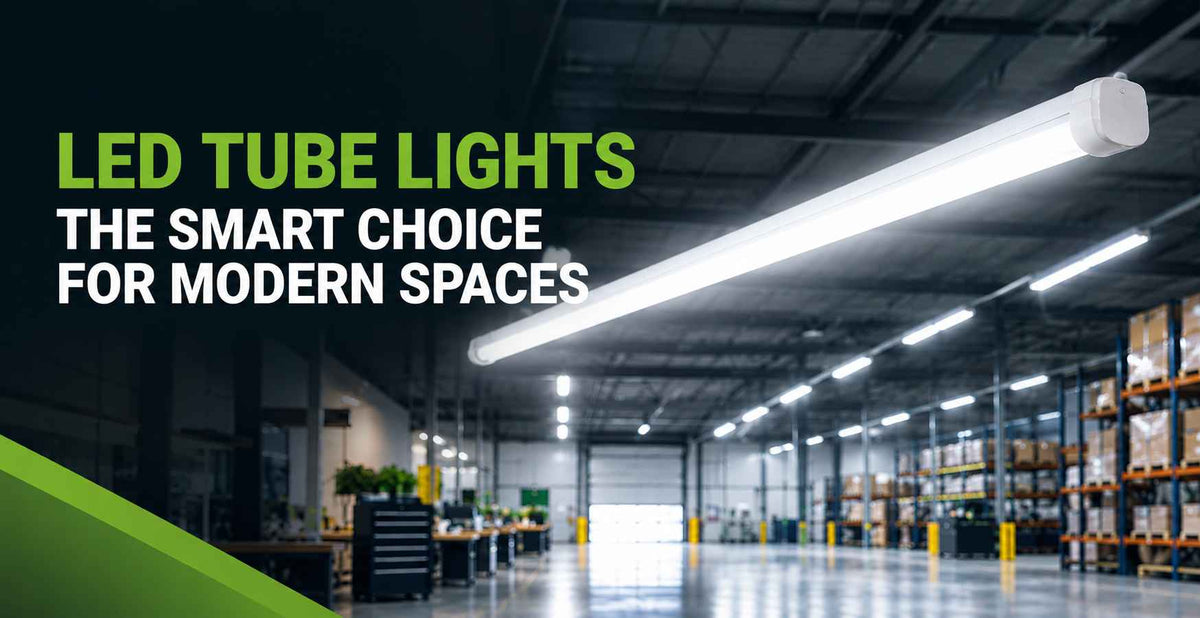
What Is LED Lighting? How It Works and Where It's Used
Walk into an older warehouse before the morning shift. The fixtures overhead hum, take a while to brighten, and two have flickered since spring. Now glance at your phone, the exit sign, the taillights outside. All LEDs.
So what is LED lighting? It's lighting that makes light by passing electric current through a semiconductor chip called a light-emitting diode. It uses far less power than older bulbs, runs cooler, and comes as anything from a screw-in bulb to a complete fixture with the LEDs built in.
We sell LED lighting at Green Light Depot, so here's the plain version: how it works, what's inside, where it fits, and the trade-offs nobody prints on the box.
What Are LED Lights, Exactly?
LED stands for light-emitting diode. The diode is a tiny semiconductor chip, and it's the only part that actually makes light. Everything else exists to power it, cool it and aim it.
That's why "what is an LED light" gets a fuzzy answer: the term covers the bare chip and two products built around it. An LED bulb or tube packs chips, a small driver and a familiar base into the old product's shape, so it drops into your existing fixture. Then there are integrated LED fixtures, with chips built in permanently; someday you replace the whole unit, not a bulb every spring.
Engineers call this solid-state lighting: no filament to snap, no gas to leak, no fragile glass to baby on a ladder. Our rule of thumb: retrofit bulbs and tubes while the fixtures are sound; go integrated when starting fresh.
How Does LED Lighting Work?
Picture a theater with two sections. One side is packed with people standing (the chip's N-type side, loaded with spare electrons). The other is rows of empty seats (the P-type side, full of "holes"). Apply voltage and the crowd crosses the aisle.
UPGRADE YOUR LIGHTING
Your Next Lighting Upgrade Starts Here
From replacing outdated bulbs to upgrading an entire commercial facility, explore LED lighting solutions designed for your space and application.
EXPLORE LED LIGHTING →Each electron that drops into a seat gives up a little energy, which leaves as a flash of light. The technical name is electroluminescence, and it's the whole trick.

Two practical details. An LED chip is directional: it throws light forward, not in every direction, so a good fixture puts more light on the floor and less on the ceiling. And chips don't naturally make white. Most white LEDs are blue LEDs under a yellowish phosphor coating; some mix different colored chips instead.
Then there's the driver. Chips run on low-voltage DC and your wall delivers AC, so the driver converts it and shields the chips from voltage swings. Many commercial fixtures accept 120 to 277 volts.
Do LED Lights Burn Out?
Rarely. Instead of dying with a pop, LEDs fade slowly, a process called lumen depreciation. Rated life, written as L70, is the point where output has dropped 30%. Heat speeds that fade more than anything, so give the heat sink room to breathe and keep its fins clean.
What Are LED Lights Made Of?
Pull apart a failed LED fixture and the chips are often still fine. Something around them gave up first.
|
Part |
What it does |
Why you should care |
|---|---|---|
|
LED chips |
Make the light, as one chip-on-board (COB) module or many small discrete chips. |
COB is one intense point; spread chips give softer light. |
|
Driver |
Turns AC wall power into steady low-voltage DC. |
Cheap ones flicker, buzz and die early. |
|
Heat sink |
Pulls heat off the chips through metal fins. |
Heat is the biggest factor in LED life. |
|
Housing |
Holds it together; keeps out dust, water and knocks. |
Match it to the location. |
|
Lens or optics |
Shapes and spreads the light. |
Decides whether the aisle or ceiling gets lit. |
|
Base (bulbs and tubes only) |
Screws or pins into the socket. |
Same standard bases as the bulbs they replace. |
Our firm opinion: the driver and heat sink decide how long an LED lasts, far more than the chip does. Two fixtures with identical chips can age very differently.
LED vs. Incandescent vs. Fluorescent: What's the Real Difference?
An incandescent bulb is mostly a heater that happens to glow. About 90% of its energy leaves as heat; LED products make light up to 90% more efficiently, according to ENERGY STAR.
|
Incandescent |
Fluorescent |
LED |
|
|---|---|---|---|
|
How it makes light |
Heats a filament till it glows |
Energized gas makes a coating glow |
Current through a chip |
|
Wasted heat |
Most of it |
Less, still warm |
Little |
|
How it ages |
Snaps; sudden failure |
Flickers, hums, then fails |
Fades slowly (L70) |
|
Mercury |
None |
A small amount |
None |
|
Warm-up |
Instant |
Slow, worse in cold |
Instant, even in a freezer |
|
Light direction |
All directions |
All directions |
Directional |
Compare lumens, not watts: watts are what a bulb eats, lumens what it gives back.
LED vs incandescent is settled: since 2023, U.S. federal efficiency standards have phased out most standard incandescent bulbs. The advantages of LED lights have their own post.
LED vs fluorescent is the closer call. LEDs win in cold rooms and under frequent switching, and they contain no mercury. Details are in our guide to LED tubes vs fluorescent tubes.
What Is LED Lighting Used For?
Your phone, the corner traffic light and your kitchen bulb all run on LEDs. Most of what we sell goes into commercial buildings, where ceilings are higher, hours longer and electric bills have more zeros.
Offices, Schools and Retail Stores
The classic job is swapping fluorescent tubes for LED tube lights. Plug-and-play tubes (UL Type A) run on the existing ballast; ballast-bypass tubes (UL Type B) wire straight to line power, which we prefer since it removes a part that can fail. One customer who retrofitted got about double the light, and the hum was gone.
FLUORESCENT TO LED
Ready to Replace Your Fluorescent Tubes?
Find LED tube lights for offices, schools, retail stores, and commercial buildings. Compare available tube options and choose the right fit for your existing fixtures.
SHOP LED TUBE LIGHTS →Warehouses, Gyms and Workshops
High ceilings change the math. The old answer was metal halide or mercury vapor, slow to warm up and hot. LED high bay lights hit full brightness instantly and shrug off frequent switching. One customer swapped two old 500-watt mercury vapor lights and called the difference, literally, night and day.
Gas Stations, Parking Garages and Drive-Thrus
A gas station canopy at 2 a.m. is a sales floor with no walls. LED canopy lights spread even light across every pump, with no dark pockets. Parking garages and drive-thru lanes want the same: safety and usable camera footage.
Image: Gas station canopy at night with even light across all of the pumps and no dark spots
Alt text: Gas station forecourt at night, lit evenly by fixtures mounted under the canopy
Parking Lots, Building Exteriors and Security
Outdoor lighting is about aiming: flood light optics push light across a lot, down a wall or along a fence, not into the sky. One business lit its perimeter with LED flood lights mounted 15 feet high and 50 feet apart.
LIGHT UP YOUR OUTDOOR SPACE
Find the Right Flood Light for Your Property
Lighting a parking lot, securing a building perimeter, or illuminating an outdoor work area? Explore LED flood lights in a range of wattages to suit different coverage needs.
SHOP LED FLOOD LIGHTS →Whatever the building, the right LED lighting fixtures match the ceiling height, the weather and the hours the lights run.
Are There Any Downsides to LED Lighting?
Yes. Better you hear the disadvantages of LED lights from us than after the install, so here's each with its fix.
Upfront cost is higher than a case of fluorescent tubes. Price it over the fixture's life, and check whether a commercial LED lighting rebate from your utility softens it.
Cheap drivers flicker, buzz and quit early. Buy from a seller who can name the driver.
Not every LED is dimmable, and dimmable ones need a compatible dimmer or they flicker. Check both labels.
Enclosed fixtures trap heat and shorten life. Some bulbs aren't rated for them; the label says so.
The wrong color temperature makes a cozy lobby feel like an operating room. Around 2700 to 3000K reads warm; 5000K and up reads cool, like daylight. Our guide to LED lighting terms covers the rest.
Spotting quality is simple: a UL or ETL safety listing on anything, and a DLC listing on commercial products, since many utility rebates use the DLC list to decide what qualifies.
LED Lighting FAQs
Do LED Lights Need Batteries?
No. Most LED lights run on building power, plugged into an outlet or hardwired, with the driver handling the AC-to-DC conversion. Battery and solar versions exist, such as flashlights, puck lights and solar street lights, and they're handy where running wire is a pain. For a warehouse or office, you'll be on the grid.
Do LED Lights Get Plugged In or Hardwired?
Either, depending on the product. Bulbs and tubes use the socket that's already wired, most integrated fixtures are hardwired, and plug-in shop lights and lamps use an ordinary outlet. One tip: ballast-bypass tubes mean rewiring the fixture to line power, so plan on a licensed electrician.
Do LED Lights Get Hot?
Yes, but far less than the bulbs they replace. An incandescent bulb sends about 90% of its energy out as heat; an LED turns most of its energy into light and routes what heat it makes into the heat sink. Warm to the touch is normal. Cooking inside an enclosed fixture it wasn't rated for is the problem.
Can I Put LED Bulbs or Tubes in My Existing Fixtures?
Usually, yes. LED bulbs use the same standard bases as the bulbs they replace, and plug-and-play LED tubes work with the existing ballast. Check two things first: whether the fixture is fully enclosed, since some bulbs aren't rated for that, and whether it's on a dimmer, which needs a dimmable bulb and a compatible dimmer.
Is Switching to LED Worth It for a Business?
For nearly any business that leaves the lights on, yes. The savings come from using less power and not paying someone to climb a lift and change lamps, and a utility rebate can trim the upfront cost. Start with the spaces that run the longest hours, like a canopy that never shuts off; payback shows up there first.
The Bottom Line
If someone asks what is LED lighting after all this, try the short version: a chip that turns electricity straight into light, wrapped in a driver and heat sink that decide how long it lives. The rest is packaging.
Next step, boring and effective: walk your building with a notepad and note every fixture that hums, flickers or is slow to brighten. That list is your project.
Green Light Depot ships across the U.S. to contractors, businesses, municipalities and property owners, with nearly 1,900 customer reviews averaging 4.9 out of 5. Browse our LED lighting solutions or call us. We like talking about this stuff, as you may have noticed.