
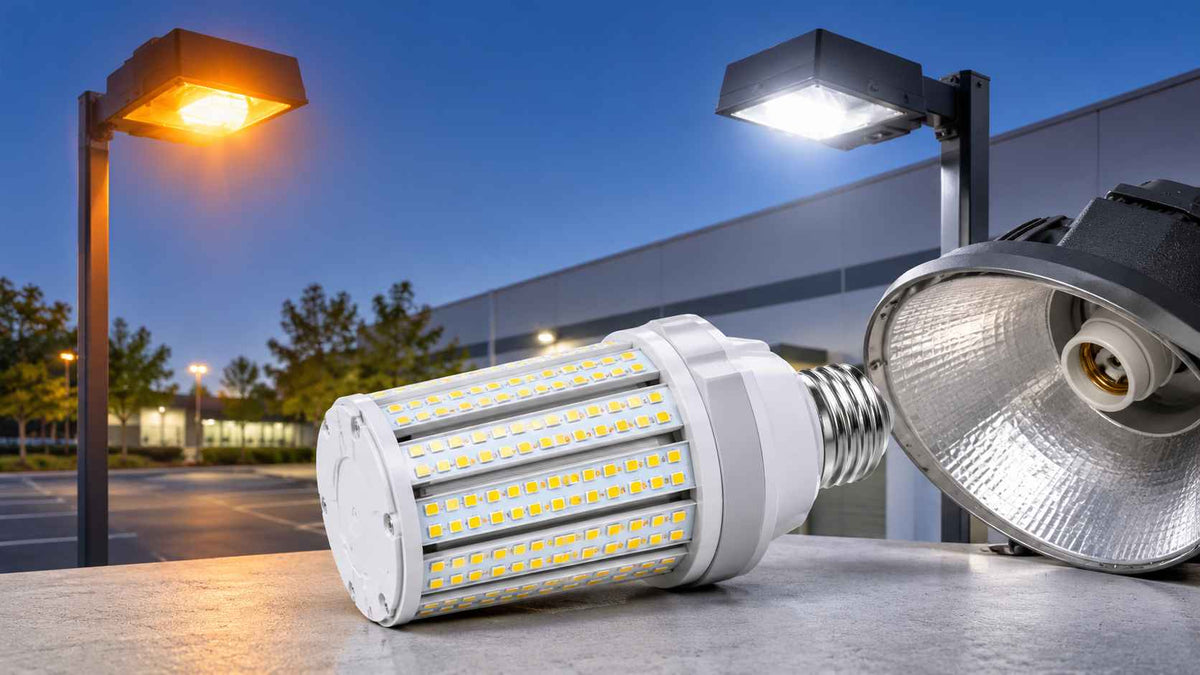
That orange glow over parking lots and older street lights comes from high pressure sodium (HPS) lamps. A high pressure sodium LED replacement does not need new fixtures. Remove the HPS lamp, take the ballast and ignitor out of the circuit, and screw in an LED corn bulb.
The CB8 LED corn bulb has a built-in wattage selector, so one bulb can be set to the light level each fixture needs.
Key takeaways
-
A 70W HPS lamp matches the CB8 36W, a 100W lamp the CB8 54W, and a 150W lamp the CB8 120W set to 80W or 100W.
-
The ballast and the ignitor must both come out. The ignitor fires starting pulses of 2,500 volts or more.
-
A typical 150W HPS fixture draws 188W with its ballast. The CB8 set to 100W draws 100W.
-
The CB8 gives 5000K white light only.
Can an LED Bulb Replace a High Pressure Sodium Lamp?
Yes. The CB8 screws into the same medium (E26) or mogul (E39) socket the HPS lamp used. What changes is the wiring behind the socket.
An HPS lamp runs on a ballast, a capacitor and an ignitor. The CB8 has its own driver and runs straight on 100–277V line voltage, so all three parts come out of the circuit.
The ignitor matters most. It starts the HPS lamp with a spike of 2.5 kV or more, and an LED driver is not built to take that. This is why an HPS to LED conversion is a small wiring job and not just a lamp swap.
Two things do not carry over. The amber color goes, because the CB8 gives white light. And dimming is not confirmed for the CB8 models sold here, so ask us before you use one on a dimming or bi-level circuit.
Which CB8 Replaces Your HPS Lamp?
Match lumens, not watts. HPS is the most efficient HID lamp, so an LED bulb that replaces a 400W metal halide lamp is often too small for a 400W HPS lamp.
Each match below gives roughly 75–95% of the HPS lamp's mean lumens, which is its output at half its rated life. White light usually looks brighter at night, and that offsets much of the gap.
|
Old HPS lamp |
HPS lumens (initial / mean) |
CB8 match |
CB8 lumens |
Base |
|---|---|---|---|---|
|
70W |
6,300 / 5,500 |
CB8 36W at full power |
4,524 |
E26 |
|
100W |
9,500 / 8,000 |
CB8 54W at full power |
6,756 |
E26 |
|
150W |
16,000 / 13,800 |
CB8 120W set to 80W or 100W |
~10,600 / ~13,200 |
E39 |
|
250W |
29,000 / 26,100 |
CB8 120W at full power (less light), or the 200W corn bulb |
15,857 |
E39 |
|
400W |
50,000 / 45,000 |
Too big for the CB8 |
n/a |
E39 |
HPS lumens are for Sylvania LUMALUX ECO clear lamps. CB8 full-power lumens come from the CB8 spec sheet. Values marked ~ are estimates that scale with wattage.
For a 150W HPS LED replacement, the 100W setting lands closest to the old lamp's mean lumens. The 80W setting suits areas that were over-lit.
Check these before you order:
-
The socket. 100W and 150W HPS lamps come with E26 or E39 bases. The CB8 54W is E26, so for a mogul socket use the 54W E39 corn bulb. The CB8 120W is E39 only.
-
250W and 400W lamps. The CB8 120W gives about 61% of a 250W lamp's mean lumens, so use it only where the area was over-lit. Otherwise the 200W LED corn bulb set to 150W or 170W is closer. For a 400W lamp, even the 200W gives about 25,000 lumens, so a new LED area light is usually the better choice.
-
Metal halide instead? The sizing works differently. See our 400W metal halide LED replacement guide.
Found Your HPS Match?
The CB8 LED Corn Bulb is available in 27W, 36W, 54W and 120W models to replace different HPS lamps. Choose from E26 and E39 base options, with selectable wattage on the 36W, 54W and 120W models.
Every model delivers 5000K white light, CRI above 80, 100–277V operation, IP65 wet-location protection and a 50,000-hour rated lifespan. All four models include a 5-year warranty. Not sure which one fits? Share your existing lamp's wattage and socket type, and we'll help you choose.
Shop the CB8 LED Corn Bulb →How to Install a CB8 in an HPS Fixture
Have a licensed electrician do the rewiring, following the NEC and your local code. The steps are short, but the work is on line voltage inside the fixture.
-
Turn off the power at the breaker and let the fixture cool.
-
Remove the HPS lamp.
-
Disconnect the ballast, capacitor and ignitor from the socket wiring.
-
Connect the line (hot) wire to the socket's center contact and the neutral wire to the shell.
-
Set the wattage selector on the CB8 to the setting from the table above.
-
Screw in the CB8 and restore power.
-
Label the fixture as ballast-bypassed, so nobody installs an HPS lamp in it later.
If you plan to replace HPS with LED across a whole site, do one fixture first. Check the light level at night, settle on a wattage setting, then repeat it on the rest.
Two checks before you start. The CB8 120W is 11.1 inches long, 5.1 inches wide and weighs 3.4 pounds, so measure the fixture and make sure the socket is in good shape. The spec sheet lists no enclosed-fixture rating, so ask Green Light Depot before you install a CB8 in a sealed fixture.
What You'll Save Switching From HPS to LED
HPS is already efficient, at 75–140 lumens per watt, so set realistic expectations. The saving comes from two places: dropping the ballast, and running fewer, whiter lumens.
Here is a typical 150W HPS fixture next to a CB8 120W set to 100W:
|
150W HPS fixture |
CB8 at 100W |
|
|---|---|---|
|
Power draw |
188W (lamp + ballast) |
100W |
|
Energy per year (12 hours a night) |
823 kWh |
438 kWh |
|
Cost per year at $0.15/kWh |
$123 |
$66 |
|
Rated life |
24,000+ hours |
50,000 hours |
That is 88W less per fixture, or 47%. Over a year it comes to about 385 kWh and $58. At the 80W setting the gap grows to 108W, or 57%, and about $71 a year.
The saving is real, but it is smaller than you would see against metal halide. The $0.15 per kWh rate is only an example, so run the numbers with your own rate.
Lamp life adds to it. At 12 hours a night, 50,000 hours is about 11 years. A 24,000-hour HPS lamp lasts about 5.5 years on the same schedule.
If this were my parking lot, I would start at the 100W setting, look at the result for a week, and only then decide whether 80W is enough.
What Changes When the Orange Light Turns White
The power bill is only part of the change. The light itself looks and behaves differently.
-
Color. HPS light is about 2000K with a CRI of 22, so colors are hard to tell apart. The CB8 is 5000K with a CRI above 80.
-
Brightness at night. 5000K light has an S/P ratio of 1.80, against 1.00 for 2200K light. That is why white light usually looks brighter at night than the same lumens of amber light.
-
Instant on. HPS lamps take 3–4 minutes to warm up and need time to cool before they restrike after a power interruption. The CB8 comes on at once.
-
When to keep amber. Near homes, under dark-sky rules, or next to HPS fixtures you are not replacing yet, a 2200K lamp may suit better. The CB8 comes in 5000K only.
A row that mixes amber and white fixtures looks uneven, so plan to convert a whole row or area at a time.
CB8 Specs at a Glance
|
Model |
Wattage settings |
Lumens (full power) |
Base |
Size (L × W) |
Weight |
|---|---|---|---|---|---|
|
27W |
27W (fixed) |
4,185 |
E26 |
6.7 × 2.3 in |
0.6 lb |
|
36W |
18W / 27W / 36W |
4,524 |
E26 |
7.5 × 3.3 in |
1.23 lb |
|
54W |
36W / 45W / 54W |
6,756 |
E26 |
9.8 × 3.3 in* |
1.43 lb |
|
120W |
80W / 100W / 120W |
15,857 |
E39 |
11.1 × 5.1 in |
3.4 lb |
*Size of the E39 version. The spec sheet does not list the E26 size.
Every model gives 5000K, 360° light with a CRI above 80, runs on 100–277V, is wet rated (IP65) and is rated for 50,000 hours. Surge protection is 4kV, or 6kV on the 120W. All are UL listed with a 5-year warranty. DLC covers selected models, so check your model on the DLC list before you apply for a rebate.
Where the CB8 Works Best
The CB8 fits best where the fixture is sound and the HPS lamp is 150W or smaller.
-
Wall packs with 70W–100W HPS lamps: CB8 36W or 54W.
-
Parking lot and shoebox fixtures with 150W lamps: CB8 120W.
-
Garages, warehouses and loading docks: CB8 54W or 120W, depending on the lamp size.
-
Street and post-top fixtures with 70W–150W lamps: use the sizing table above.
If the fixture itself is worn out, with a yellowed lens or a corroded housing, a new bulb will not fix it. A new LED wall pack or LED street light is the better buy.
The Bottom Line
For 70W–150W HPS fixtures, the CB8 is a low-cost way to get white, instant-on light without new fixtures. Match by lumens, take out the ballast and the ignitor, and set the selector to the light you need. For 250W and 400W lamps, go bigger or replace the fixture. You can compare sizes across our LED corn bulbs.
Found Your HPS Match?
The CB8 LED Corn Bulb is available in 27W, 36W, 54W and 120W models to replace different HPS lamps. Choose from E26 and E39 base options, with selectable wattage on the 36W, 54W and 120W models.
Every model delivers 5000K white light, CRI above 80, 100–277V operation, IP65 wet-location protection and a 50,000-hour rated lifespan. All four models include a 5-year warranty. Not sure which one fits? Share your existing lamp's wattage and socket type, and we'll help you choose.
Shop the CB8 LED Corn Bulb →High Pressure Sodium LED Replacement: FAQs
Can I put an LED bulb in a high pressure sodium fixture?
Yes, once the ballast, capacitor and ignitor are out of the circuit. The CB8 then runs directly on 100–277V line voltage through the same E26 or E39 socket the HPS lamp used.
Do I have to remove the ignitor?
Yes. The ignitor sends starting pulses of 2,500 volts or more to strike the HPS lamp. An LED driver is not built to take them, so disconnect the ignitor along with the ballast and capacitor.
What LED replaces a 150W HPS lamp?
The CB8 120W, set to 80W for about 10,600 lumens or to 100W for about 13,200 lumens. It has a mogul (E39) base, so check that your socket is a mogul before you order.
What LED replaces a 70W HPS wall pack lamp?
The CB8 36W at full power, which gives 4,524 lumens and has a medium (E26) base. If the wall pack was brighter than it needed to be, set the selector to 27W.
Will the LED look brighter than the HPS lamp?
Usually, yes, even with fewer lumens. 5000K white light has an S/P ratio of 1.80 against 1.00 for 2200K light, so it reads brighter at night than amber light does.
Can I keep the amber HPS color?
Not with the CB8, which comes in 5000K only. If you need to match nearby HPS fixtures or follow a dark-sky rule, choose a 2200K LED lamp for that area instead.
Is the CB8 DLC listed?
Selected models are, not the whole range. Check your exact model on the DLC list before you apply for a rebate. Every CB8 model is UL listed and has a 5-year warranty.